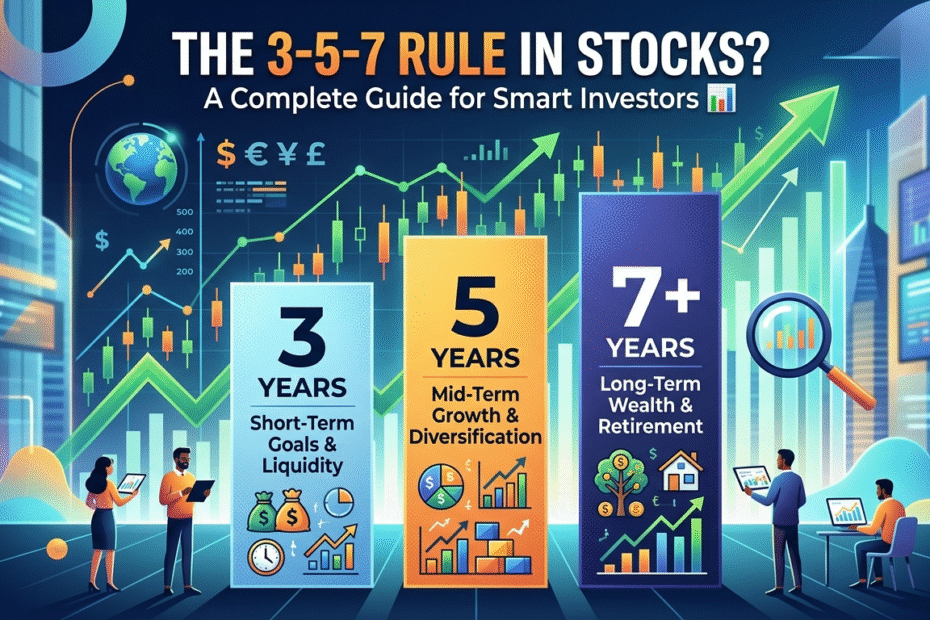
📊 The 3-5-7 Rule requires basic understanding for its fundamental operation.
The majority of stock traders follow basic rules to protect their invested funds according to stock market research. One of the most popular among these is the 3-5-7 rule in stocks. Traders use this risk management rule to handle their trading losses while maintaining their trading discipline and enhancing their ability to achieve profits over extended periods.
The 3-5-7 rule requires traders to assess three essential trading elements which include their risk per trade and their total market exposure and their targeted profit. Investors can maintain their portfolio protection during market fluctuations by establishing these boundaries which help them control their emotional state. Financial experts often emphasize that risk management is more important than predicting the market correctly. Every trader, including the most skilled ones, will face losing trades at some point.
The rule breaks trading decisions into three easy-to-remember numbers: 3%, 5%, and 7%. The percentages function as risk management tools which help investors establish their expected profit achievement. Trading educators and financial resources show that the rule recommends traders to risk 3% of their capital on one trade which builds to 5% for all active trades while traders should aim for 7% profits on their successful trades.
The beauty of this rule lies in its simplicity. Traders use a structured framework to make decisions instead of guessing or reacting on impulse. People must follow traffic rules when they drive because traffic rules protect others from driving mistakes. The absence of rules creates disorderly situations while established rules create safer environments with orderly operations.
📈 The Importance of Basic Trading Rules for Stock Market Operations
Stock markets create emotional spaces where traders operate. Investors react to news which travels fast and drives stock prices to change instantly. Traders who operate without a plan face major risks because they can easily lose their entire investment through single trades and they will keep losing stocks. The 3-5-7 rule functions as an essential tool because it provides traders with a structured approach to their work.
Traders maintain their focus on their tasks through basic rules. The approach decreases decision-making stress while it stops traders from responding emotionally to market fluctuations. Imagine losing 20% of your portfolio on a single bad trade. This type of financial loss creates a confidence crisis which leads to more dangerous decision-making. Your strategy remains intact because you stay composed after losing only a small amount of your investment.
The implementation of basic rules delivers a second benefit which creates predictable outcomes. Traders who execute identical procedures multiple times acquire the ability to examine their outcomes while developing better methods throughout different periods. The practice of consistent trading establishes a business approach to trading which moves away from gambling activities.
Traders who work at professional level make capital protection their top priority which they consider essential for success. You can start your trading activities again tomorrow if you safeguard your investment capital. Your strategy loses all value when you no longer possess any capital.
🔢 The Meaning Behind the Numbers 3-5-7
The 3-5-7 rule might sound mysterious at first, but the numbers simply represent guidelines for risk management and profit targets. The three numbers enable traders to establish their trading strategy while they approach market activities.
📉 The 3% Risk Rule Explained
The rule begins with the first number 3% which indicates the highest portion of your capital that you should risk during one trade. In simple terms, if the trade goes wrong, you should not lose more than 3% of your total trading account.
If you have a trading account that holds $10,000, your account balance functions as your example. The rule states that you should not permit any trade to result in a loss that exceeds $300, which represents your maximum allowable loss. The stock price movement against you requires your stop-loss to be positioned in a manner that restricts your loss to the specified amount.
The reason for this significance exists because professional traders still commit errors in their work. Your trading account will experience major losses when you choose to risk an excessive amount of money on a single trade. You can protect your portfolio from total loss through multiple losing trades when you set your risk limit at 3%.
The process of position sizing determines the number of shares which traders should purchase according to their individual risk tolerance.
💰 The 5% Total Exposure Rule
The strategy uses 5% as its second number which shows all active trades together create total risk of 5%. The rule protects your capital because it limits your market exposure to safe levels.
The total risk from your open positions must stay below 5% of your trading capital according to this rule.
Why is this important? The markets contain unpredictable movement patterns which emerge from economic developments and political announcements and sudden shifts in investor attitudes. Multiple simultaneous losing trades create a situation where financial losses accumulate at an accelerated rate.
The 5% rule requires traders to spread their funds across multiple markets and sectors which protects them against total financial loss. Traders protect themselves from financial danger by spreading their investments across various asset classes instead of putting everything into one investment.
This method protects against extreme financial losses while it supports portfolio performance throughout time.
🎯 The 7% Profit Target Strategy
The final part of the rule focuses on profit. The 7% guideline requires traders to target a minimum 7% profit for successful trades which must exceed their losing trades.
Why is this important? Because trading success depends on the relationship between risk and reward. Your winning trades will exceed your losses when you risk 3% to achieve a 7% profit.
Let’s imagine a trader makes ten trades:
5 trades lose 3% each
5 trades gain 7% each
The portfolio experiences growth because the total gains exceed the total losses. Professional traders use this concept of maintaining a positive risk-reward ratio as their essential guideline.
⚠️ How the 3-5-7 Rule Helps Manage Trading Risk
Successful investing depends on effective risk management which serves as its fundamental element. The absence of proper risk management will cause even the most exceptional strategy to collapse. The 3-5-7 rule enables traders to safeguard their capital while they search for trading opportunities which can generate profits.
🛡️ Protecting Your Capital
New traders commit their most significant error when they allocate excessive funds to one trade. Traders who believe in the success of a specific stock will allocate their funds towards that stock. The trade failure will result in major losses for them.
The 3-5-7 rule prevents this problem by setting strict limits on risk exposure. The total losses from multiple failed trades remain within manageable limits. This method enables traders to maintain their market presence until they discover additional profitable chances.
Trading functions as a marathon which requires an extended period to complete. The goal is not to win every race but to stay in the game for the long term.
⚖️ Developing a Balanced Risk-Reward Ratio
The rule provides its second benefit because it establishes a system which requires traders to maintain equal risk and reward proportions. Many inexperienced traders focus only on potential profits while ignoring the downside risk.
Traders who target 7% gains while risking 3% will achieve successful results because their winning trades will exceed their losing trades. The mathematical advantage provides cumulative benefits which enhance total business profitability.
Successful investors understand that consistent small gains are often better than chasing large unpredictable profits.
📊 Real-World Example of the 3-5-7 Rule
The 3-5-7 rule functions through its connection to real-world applications.
The rule establishes three trading limits which will lead to the trader’s maximum allowable loss of 300 dollars.
The first rule of risk management state that traders should limit their maximum loss to three percent of their trading account balance.
The total market exposure should not exceed five percent which results in maximum total risk of five hundred dollars.
The target profit amount for the trade reaches seven hundred dollars.
A trader finds an attractive technology stock investment opportunity and chooses to implement the 3-5-7 rule for their trade.
The stop-loss protection mechanism establishes three hundred dollar limit as their maximum loss capacity.
The total risk from their active trades should not exceed their established limit of five hundred dollars.
The trade will result in success if they reach their profit target which they have set at seven hundred dollars.
The structured method guarantees traders will follow trading rules while avoiding impulsive trading choices.
✨ Benefits of the 3-5-7 Rule
The3-5-7Ruleprovides traderswith multiple benefits,which include establishing better emotional control. Traders who understand their maximum risk limits will experience less trading anxiety,which will help them make better decisions. Investors tend to make poor investment decisions because they experience both fear and greed.
Traders use the 3-5-7 rule to establish a trading plan,which helps them reduce their trading execution uncertainty.
📊 Improved Investment Methods
The second benefit results from traders achieving better portfolio balance. Traders establish their investment strategy stability by using exposure limits together with risk management practices.
They create an investment portfolio that maintains market stability by starting with small investments in various stocks.
⚠️ Limitations of the 3-5-7 Rule
Not Suitable for Every Trading Style
The rule provides benefits but it does not function as a complete solution. Different traders have different strategies, risk tolerances, and time horizons. Risk management techniques which long-term investors use differ from those which short-term day traders prefer.
The financial markets operate as unpredictable systems which undergo continuous changes. The application of strict regulations restricts traders from achieving maximum profits while they need to adjust their strategies according to market developments.
The rule should function as a guideline which traders use to make decisions instead of treating it as an unbreakable law.
🧠 Tips for Successful Implementation of the 3-5-7 Rule
The Stop-Loss Strategy needs to be used together with it.
The 3% risk rule needs stop-loss orders because they serve as its main operational mechanism. Traders need stop-loss orders to control their possible financial losses effectively.
Employ Technical Analysis and Fundamental Analysis
The rule requires stock analysis to be conducted through proper channels. Before making trading decisions investors must assess company fundamentals together with industry trends and technical indicators.
Traders achieve better results when they combine risk management with analysis methods.
✅ Conclusion
The 3-5-7 stock trading rule provides traders with a fundamental system which they can use to control their trading risks and maintain their trading discipline while achieving better results in their trading activities over time. The investors establish a proper risk-reward system which safeguards their investment through three trading rules that limit their risk to 3 percent and their total investment to 5 percent and their profit target to 7 percent.
The stock market operates as an unpredictable environment which offers no guarantee for successful trading methods. The disciplined method of risk management leads to higher probabilities of achieving sustainable business expansion. The 3-5-7 rule provides investors with a reminder that successful trading requires continuous smart decision-making which protects capital instead of relying on quick financial gains through massive profits.