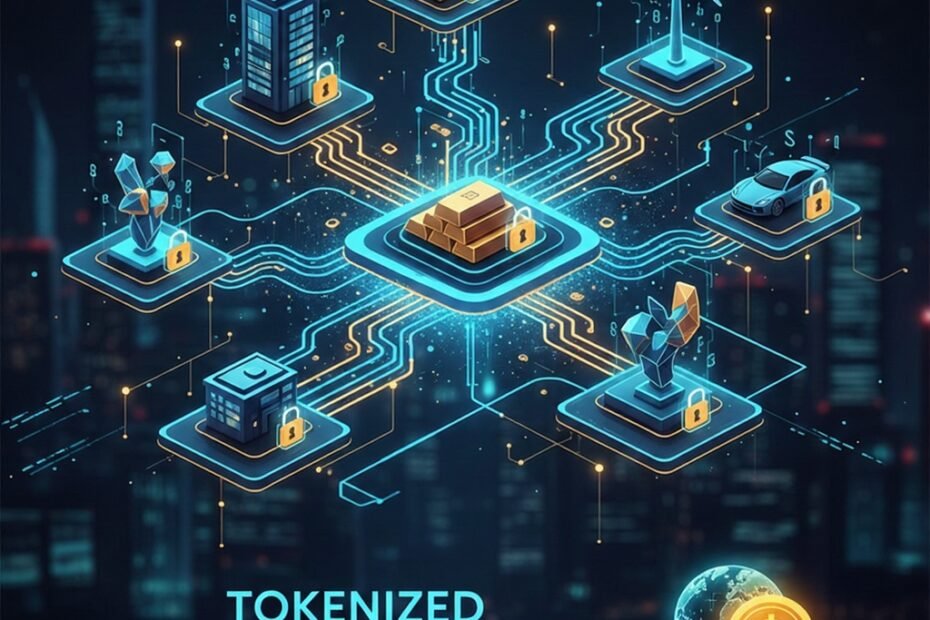
🔗NFTs, As the world got obsessed with digital art and collectibles, a more significant and financially interesting revolution is taking place in the blockchain community — “Tokenization of Real-World Assets (RWAs). This isn’t about novelty speculative crypto-art; this is investment management, and it has the potential to redefine the bedrock of global finance by democratising access to trillions of dollars worth of illiquid assets like real estate, fine art auctions or a metal commodity.
Tokenization transforms the ownership of a physical or intangible asset into a digital token on a blockchain. It’s like making a digital, fractional certificate of ownership, and it is transparent, secure and easy to transfer. This simple notion stands ready to release amounts of liquidity, access and utility into markets that historically have been walled-off or inefficient.
Why Now? The Perfect Storm for Tokenization
Several forces are driving the RWA tokenization frenzy:
📈 Mature Blockchain Infrastructure: Networks such as Ethereum, Stellar and Polygon now have the security, scalability and level of regulatory compliance required for high-value assets.
💡 Institutional Demand: Leading financial institutions such as BlackRock, J.P. Morgan and Goldman Sachs are actively researching and investing in blockchain-based asset solutions.
🛡️ Regs Clarity: Governments And Regulatory Bodies Across The Globe Are Slowly Coming Out With Frameworks For Digital securities, providing the guardrails needed for mass adoption.
Applications: Use cases for tokenization
Time to take a look at some examples. Here’s how companies are already using RWA tokenization.
🏠 1. Real Estate: Unlocking Property Value
Real estate is the first proving ground for RWA tokenization. The way things are as I write this in October 2019, it takes a shitload of money to buy a commercial skyscraper or a premium residential building. Tokenization shatters this barrier.
Company Example: RealtT
RealT lets users invest in tokenized shares of rental properties throughout the United States. Each building is its own LLC, and ownership takes the form of tokens on the Ethereum cryptocurrency network. The new platform allows token holders to receive weekly rental income in the form of Ethereum, creating a more accessible way for the wider community to benefit from this relatively stable and revenue-generating asset class – one that was once only made available to those who have large amounts of funds.
Hypothetical Business Model: “TokenizeREIT”
A startup could issue a tokenized Real Estate Investment Trust (REIT). Rather than obtaining shares through a broker, investors buy tokens. This could save management fees, allow 24/7 global trading and provide instantaneous settlement – solving many of REITs’ major pain points.
🎨 2. Fine Art & Collectibles: Fractionalized Works Of Art
The high-value art world is rarefied and illiquid. Tokenization is changing the canvas.
Company Example: Maecenas
Through this platform, you can own a share of a Picasso or a Warhol. Maecenas tokenizes art masterpieces to fractionalize ownership. Investors can sell off their shares on the secondary market, and the work is locked in a vault. This model offers liquidity to art owners and access to a new asset class for people around the world.
⚡ 3. Commodities & Carbon Credits
Whether through gold, lithium or carbon credits, tokenization is introducing transparency and efficiency to commodity markets.
Company Example: Paxos Gold (PAXG)
Every PAXG token is backed by one fine troy ounce of a London Good Delivery gold bar, stored in Brink’s vaults. Holders own the actual underlying gold and can trade it 24/7 anywhere in the world immediately with no hassle of physical delivery.
Hypothetical Business Model: “GreenChain Credits”
A DAO (Decentralized Autonomous Organization) might tokenize carbon credits accrued from a certified reforestation effort. Businesses and people could then buy these tokens to make up for their carbon footprint. The blockchain would enable a permanent, transparent global record of who owned and retired which credits at what time – addressing fraud in the carbon market (which is one of the greatest concerns for climate adaptation businesses).
Expert Insight: The Regulatory Frontier
For depth, we chatted with Anya Petrova, a partner in blockchain-focused law firm and RegTech advisor.
“The number one challenge for RWA tokenization is not technology — it’s regulation. Securities laws should be applied to all tokenised assets as a first order approach. Is it a security? The answer is usually yes, and that also means no getting around KYC (Know-Your-Customer), AML (Anti-Money Laundering) and accreditation laws.
The rise of advanced RegTech tools is a game changer. Platforms which provide on-chain identity and automated compliance are becoming the plumbing required for us to scale this industry in a secure, legal manner.”
Key Takeaways: Recommended Resources: Quotes from the Episode: Earn As You Learn From JT as Your Personal Trade Mentor!
Interested in testing the waters of tokenized real estate and other RWAs? Here are practical steps.
Learn: Differentiate between security tokens (carrying a financial value) and utility tokens (grants access to a service). Most RWAs are security tokens.
Opt for a Compliant Platform: Do not purchase tokenized RWAs at the usual crypto exchanges such as Binance. You have to do fractional equity on licensed and regulated platforms. Look for platforms that explicitly state their regulatory status (e.g., licensed broker-dealers).
Finish Your KYC/AML: Get ready to prove you are who you say you are. This is an indication of a trusty platform, which follows the laws related to the financial activity.
Keep It Modest: The market is still small. Start off small to learn how to purchase, hold and potentially sell the asset.
Move Your Tokens: After you buy your token, move them from the platform to a wallet for which someone else does not control the private keys (a Ledger or Trezor).
Platforms to Research:
RealT: For U.S. rental properties.
Oasis Pro Markets & tZERO: For more types of digital securities.
Securitize & ADDX: Token issuer for private equity and venture capital.
The Future is Tokenized
This is only the beginning of RWA tokenization. We are hurtling toward a world in which in addition to those mutual fund shares, or that municipal bond, your 401(k) could own the equivalent of a small chunk of a co-worker’s Manhattan apartment building, and perhaps some rental properties in Asia and an at-risk show on Bollywood — all represented through tokens issued by those individual assets and held digitally.
Creates a new financial system that is more inclusive, transparent and efficient. The regulatory obstacles persist, but the direction is clear. The bridge between traditional finance and the cryptosphere is under construction, and it’s being built with tokenized real-world assets.
It is not a question of if we will tokenize assets, it’s how fast will the world move into this new era.