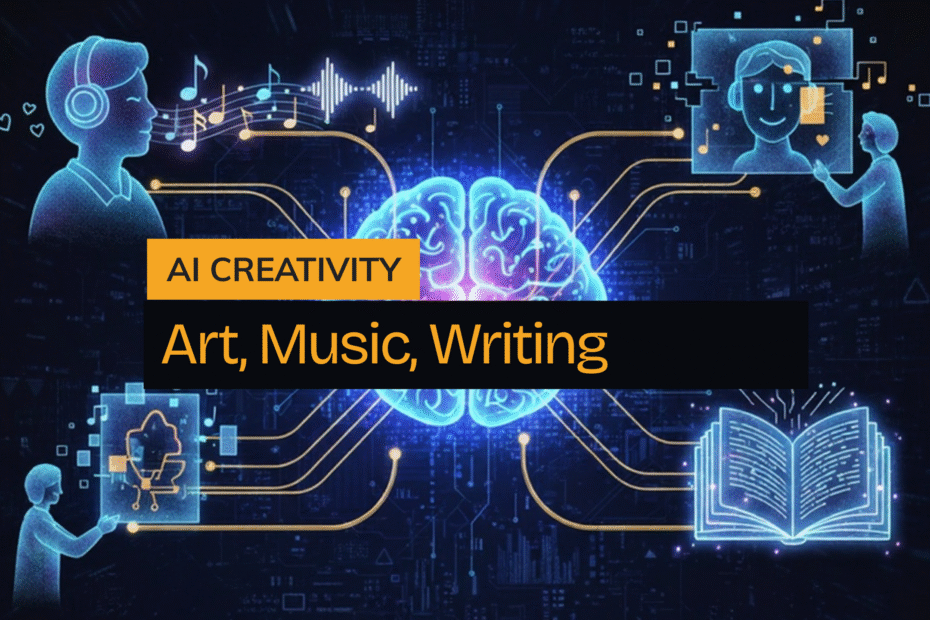
Artificial Intelligence has transcended from a far-off promise to an ally in the creative process — generating works that not only follow along human lines of creativity, but challenge and inspire us with their novelty.
This is no cold, mechanical replication. It’s a new renaissance, enabled by the age of neural networks that have learned the nuances — patterns, structures and emotions — buried in our cultural masterworks. Let’s take a look at how AI is doing this in visual art, music and writing — and why audiences are reacting so passionately.
🖼️ The AI Art Gold Rush:
Midjourney, DALL-E and Stable Diffusion democratized art-making. Users can type a descriptive sentence–a “prompt” if you will–and voila, stunning high-res images appear as if by magic.
How It Works: These AI models learn from billions of image-text pairs that it scrapes from the internet. They are learning the correspondence between words and images. So when you tell it “a melancholic robot looking at a sunset in a cyberpunk city,” the AI doesn’t “understand” the words, but on the basis of its massive training data set comes up with combinations of pixels that statistically fulfill this description.
The Human Connection: The magic here isn’t just in the output of the AI, but in the input from a human. The finest AI art is produced by iterative refinement — a dialogue between the human and the machine. The artist leads, selects and invests the work with meaning. The result is often a distinctive synthesis of the artist’s vision and the AI’s ability to produce head-scratching weirdness, familiar yet utterly fresh art.
🎵 Composing the Future: AI in Music – Do You Hear Sound as Music?
When it comes to music, AI is functioning as a co-writer and producer — and even as a virtual performer. Tools such as AIVA (Artificial Intelligence Virtual Artist), Amper Music and OpenAI’s Jukebox are writing original film scores, video game soundtracks or albums.
How It Works: These systems are trained on large-scale datasets of music, ranging from Beethoven to The Beatles to contemporary electronic music. They study theory and structure, harmony, even the “texture” of different forms. You can feed this AI all sorts of information — a mood, genre or even just the beginnings of a melody — and it will produce an entire song with multiple instruments.
The Human Connection: AI is great for getting past a creative block by spewing out endless variations of an idea. A musician could overlay their own live vocals and guitar over a computer-generated drum loop or chord progression created by A.I. The coalition is an opportunity for artists to delve into sonic terrain they may not have ventured toward alone, resulting in the type of music that is innovative yet instantly relatable.
✍️ A Writer’s New Assistant: AI-Powered Prose
With options to generate everything from marketing copy to poetry & novel chapters, AI writing tools like Jasper, Copy.ai and ChatGPT are now generating fluent, coherent text that is engaging to read.
How It Works: Big Language Models (BLMs) are trained on a bunch of the text that can be compiled from the internet. They are learning grammar, style, facts and modes of narration. Given a prompt, they can predict the most likely sequence of words that should come next, enabling them to write essays, scripts and stories in the voice of a particular author.
The Human Connection: The secret to good AI writing is the “human-in-the-loop” model. The AI is a strong ideation and drafting tool, but the human is the editor, curator of voice, prodigy of genuine insight and emotion. Writers use A.I. to brainstorm, beat writer’s block or develop first drafts — which they then revise, fact-check and bring their own perspective to flesh out.
💡 Expert Insight: The Legal and Business Framework
For some context, I spoke with Anya Petrova, partner at popular VC firm investing in web3 and creative tech.
On Authenticity and Value:
“The debate around AI art isn’t whether the work is high quality—it’s already proved that. Instead, the question is one of provenance and value. We are witnessing a boom in startups developing ‘provenance layers’ on top of the blockchain. This means that artists can cryptographically prove whether they are the prompt-engineer and curator of an AI-generated piece, generating the scarcity and authenticity that the art market lusts for.”
On the Future of Creative Work:
“AI won’t replace artists; it will replace artists who don’t use AI. Those who can master these tools will be the most successful creatives of tomorrow, just as photographers learned Photoshop. We are investing in platforms that reduce the barriers to creativity and open up paths to new monetization, such as fractional ownership of AI-art portfolios.”
🚀 Your Turn: How to Begin Building with AI
You don’t need a PhD in computer science to tinker with AI creativity. Here’s how to get started.
For Aspiring AI Artists:
- Begin With a Platform: Open an account — free for Midjourney (on Discord), DALL-E 2. Their easy to navigate interfaces are good for people new to trading.
- How to Craft a Prompt: Your brush is your word choice. Be descriptive. Include artist’s style (e.g., ”in the style of Van Gogh”), medium (“oil on canvas”) and mood (“ethereal, “dramatic”).
- Iterate and Refine: Your first result is a starting point. Leverage its “variate” options and modify your prompts to steer the AI closer to what you had in mind.
For Musicians and Composers:
- Try AI Music Tools: AIVA for classical and cinematic scores or Boomy to create fast, AI-generated song starters in pop and electronic styles.
- Turn A.I. Into a Bandmate: Input a simple melody that you’ve written into an artificial intelligence tool, and ask it to generate a bassline and drums in the style of your choice. Use what you like and discard the rest.
- Play around with Sound Design: Tools like Google’s NSynth Super allows you to generate completely unique hybrid instrument sounds for your productions.
For Writers and Content Creators:
- Tap into Writing Assistants: Tap Jasper for long-form content such as blog posts, ChatGPT for brainstorming, outlining, and drafting emails or social media posts.
- Create a Workflow: Make Sure Not to Simply Copy-Paste What the AI Gives You. Use it to:
- Brainstorm 10 headline ideas.
- Write your outline for an article up to 1000 words.
- Draft a difficult introductory paragraph.
- Always Edit and Fact-Check: The AI’s first draft is just that — raw material. Its your knowledge, your voice, and the accuracy of it is what really makes it a good finished product.
🔮 The Future is Collaborative
It is not “human versus machine” but rather “human with machine.” AI is a wonderful enabler that magnifies our creative instincts, it takes care of the boring bits of execution and presents us with a universe of possibilities at our fingertips. It’s extending the terms of what we think about when we think about art, music and literature, but it is also helping us realize something new and old about our own human creativity: The more that A.I. learns and evolves, the more uniquely human one realizes these things. We don’t fall in love with a work that the AI generates on its own, but rather one produced through the beautiful and unpredictable merging of human intentionality and artificial intelligence.